
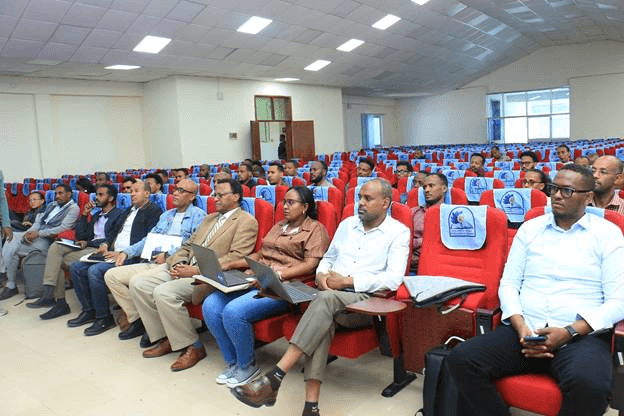
A Training of Trainers (ToT) on Virtual Reality (VR) for lecturers from Ethiopia’s universities of applied sciences opened today at Kotebe University of Education in Addis Ababa. The training aims to equip participants with the knowledge and skills to use VR, Augmented Reality (AR) and simulation in teaching and assessment. It forms part of the Methodologies and Didactics Education for Universities of Applied Sciences (MaDE-for-UASs) project.

After an introduction by the project coordinator, Dr. Teshome Nekatibeb, President of Kotebe University of Education, welcomed participants and officially opened the workshop. He traced Ethiopian education’s long journey in using technology to make teaching and learning more engaging, and described MaDE-for-UASs as a timely project that will strengthen teaching at universities of applied sciences. He stressed that integrating VR, AR and simulation effectively would significantly improve course delivery by making learning more engaging, hands-on and experiential.
Dr. Teshome said that the training would give participants the chance to build and sharpen their skills in using these technologies in the classroom, and urged them to take an active part. He also reminded them that they carry the responsibility of passing on what they learn to colleagues at their home universities, so that the project’s benefits endure after it ends. Finally, he thanked Guzo Technology, the partner that is running the workshop with MaDE-for-UASs.
Dr. Ephrem Tekle, Project Coordinator, presented an overview of the project and outlined what is expected of participants during and after the training. He noted that building the capacity of lecturers at universities of applied sciences is one of the project’s key deliverables. So far, three rounds of training have been held, equipping a good number of instructors to use VR in their teaching.

The four-day ToT, running from November 3 to 6, 2026, brought together lecturers from 17 universities of applied sciences. The project aims to train 3,000 university lecturers in total, and those attending this training are expected to train others when they return to their institutions. Dr. Ephrem emphasized the importance of making teaching at universities of applied sciences practical, and said the training would strengthen instructors’ ability to integrate the technology into their teaching.

Co-funded by the EU, MaDE-for-UASs project is implemented by Kotebe University of Education, Dire Dawa University, Aksum University, Assosa University, St. Mary’s University, FDRE TVT Institute, ThumbsUp Social Entrepreneurs PLC, Heilbronn University of Applied Sciences (HHN), Technische Hochschule Ostwestfalen-Lippe (TH OWL), and the Free University of Bozen-Bolzano (UNIBZ).
Recent Comments